

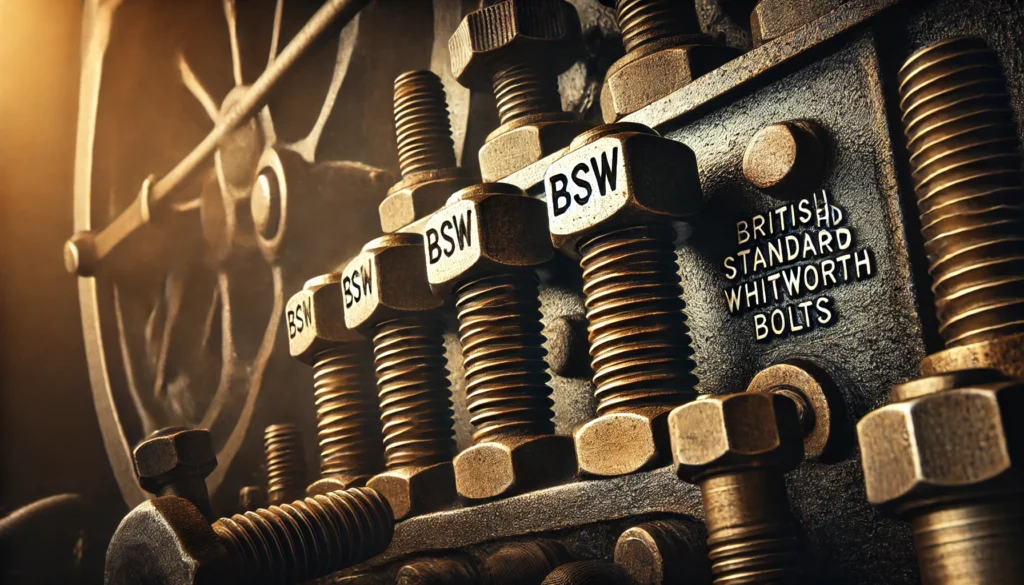
The British Standard Whitworth (BSW) thread was one of the first standardized thread forms and is still used in mechanical engineering, vintage machinery, and construction. It features a 55° thread angle, which is different from the 60° Unified Thread Standard (UTS) used in UNC, UNF, and UNJ threads.
Although BSW has largely been replaced by metric and Unified threads, it remains popular for legacy equipment, restoration projects, and heavy-duty applications.

Key Features of BSW Threads:
✔ 55° thread angle (different from the 60° Unified thread form).
✔ Rounded crest and root profile, reducing stress concentration.
✔ Widely used in older British machinery and structural engineering.
✔ Higher durability in heavy-load applications, due to its coarse pitch.
Common Applications of BSW Threads:
- Restoration of vintage machinery (older British-made machines, vehicles, and tools).
- Structural & mechanical engineering (heavy-duty fasteners in steel structures).
- Railway & shipbuilding industries (British-made equipment and infrastructure).
- Automotive & motorcycles (classic British cars and motorcycles such as Triumph, Norton, and BSA).
- General-purpose engineering (widely used in workshops and construction fasteners before metrication).
This standard is closely related to:
- BSF (British Standard Fine) (A finer-pitch version of BSW, used where higher strength is required.)
- UNC (Unified National Coarse) (Modern coarse-pitch alternative based on a 60° thread angle.)
- UNF (Unified National Fine) (Used for precision applications where finer threads are needed.)
Technical Specifications
BSW threads differ from Unified threads (UNC, UNF) primarily in thread angle and root profile.
BSW Thread Profile Parameters
- Thread Angle: 55° (compared to 60° for Unified threads)
- Crest & Root: Rounded to reduce stress concentration
- Tolerances: Defined by BS 84 (British Standard 84) and ISO 261
BSW Standard Thread Sizes & Dimensions
The following tables provide both inch and metric equivalents for major, pitch, and minor diameters, as well as recommended tap drill sizes for commonly used BSW threads.
BSW Thread Dimensions (Inches)
| Nominal Size | Threads Per Inch (TPI) | Major Diameter (in) | Pitch Diameter (in) | Minor Diameter (in) | Tap Drill Size (in) |
|---|---|---|---|---|---|
| 1/16″ | 60 | 0.0625 | 0.0536 | 0.0452 | 0.0400 |
| 3/32″ | 48 | 0.0938 | 0.0818 | 0.0724 | 0.0670 |
| 1/8″ | 40 | 0.1250 | 0.1109 | 0.1001 | 0.0950 |
| 5/32″ | 32 | 0.1562 | 0.1404 | 0.1283 | 0.1210 |
| 3/16″ | 24 | 0.1875 | 0.1681 | 0.1537 | 0.1480 |
| 1/4″ | 20 | 0.2500 | 0.2245 | 0.2065 | 0.1960 |
| 5/16″ | 18 | 0.3125 | 0.2833 | 0.2634 | 0.2560 |
| 3/8″ | 16 | 0.3750 | 0.3417 | 0.3197 | 0.3120 |
| 7/16″ | 14 | 0.4375 | 0.3988 | 0.3742 | 0.3650 |
| 1/2″ | 12 | 0.5000 | 0.4537 | 0.4269 | 0.4190 |
| 9/16″ | 12 | 0.5625 | 0.5157 | 0.4889 | 0.4800 |
| 5/8″ | 11 | 0.6250 | 0.5760 | 0.5480 | 0.5360 |
| 3/4″ | 10 | 0.7500 | 0.6920 | 0.6600 | 0.6480 |
| 7/8″ | 9 | 0.8750 | 0.8060 | 0.7710 | 0.7590 |
| 1″ | 8 | 1.0000 | 0.9170 | 0.8800 | 0.8720 |
BSW Thread Dimensions (Metric – mm)
| Nominal Size | Major Diameter (mm) | Pitch Diameter (mm) | Minor Diameter (mm) | Tap Drill Size (mm) |
|---|---|---|---|---|
| 1/16″ | 1.59 | 1.36 | 1.15 | 1.02 |
| 3/32″ | 2.38 | 2.08 | 1.84 | 1.70 |
| 1/8″ | 3.18 | 2.82 | 2.54 | 2.41 |
| 5/32″ | 3.97 | 3.57 | 3.26 | 3.07 |
| 3/16″ | 4.76 | 4.27 | 3.91 | 3.76 |
| 1/4″ | 6.35 | 5.70 | 5.25 | 4.98 |
| 5/16″ | 7.94 | 7.20 | 6.69 | 6.50 |
| 3/8″ | 9.53 | 8.68 | 8.12 | 7.92 |
| 7/16″ | 11.11 | 10.13 | 9.50 | 9.27 |
| 1/2″ | 12.70 | 11.53 | 10.85 | 10.64 |
Related Inch-Based Thread Standards

- BSF – British Standard Fine (Finer pitch version of BSW, offering higher strength.)
- UNC – Unified National Coarse (Modern coarse-pitch alternative with a 60° thread angle.)
- UNF – Unified National Fine (Used for precision applications requiring fine threads.)
- UNEF – Unified National Extra Fine (Specialized extra-fine threads for precision engineering.)
Important Notice on Standards Validity
This information is for reference purposes only. Users should consult official sources and updated standards to ensure compliance with current regulations. The validity of standards may change over time, so it is recommended to verify them through recognized engineering and standardization organizations (BSI, ISO, ANSI, ASME, etc.).
Check with relevant standardization bodies in your region to confirm whether a specific standard is still valid and applicable. Regulations and industry requirements may vary based on region and application.