
DIN 63 specifies slotted countersunk head screws, commonly used in various mechanical and structural applications requiring a flush surface finish. These screws are designed to be installed with a flat or countersunk profile, ensuring minimal protrusion above the surface.
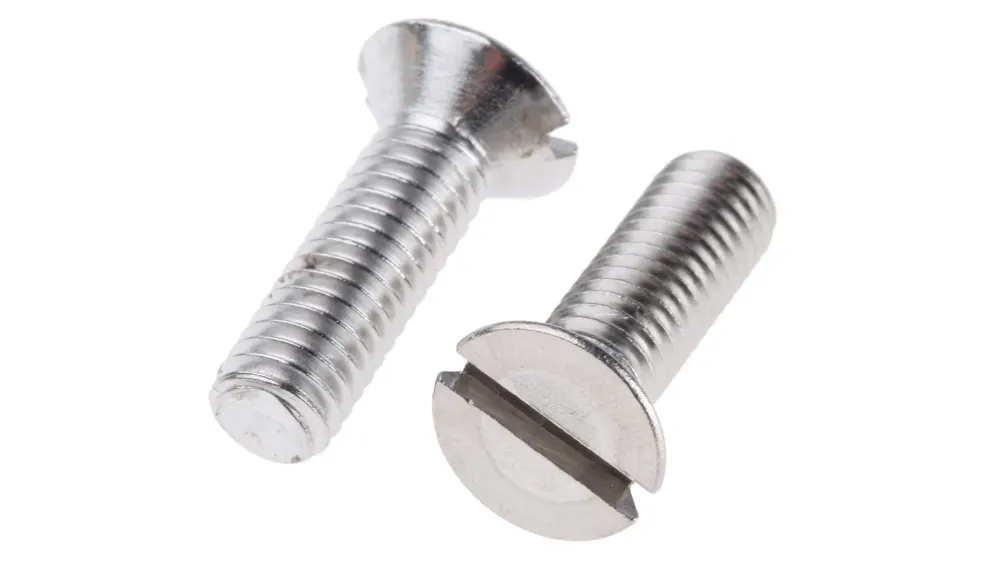
Key Features of DIN 63 Screws
- Head Type: Countersunk (flat head) with a 90-degree angle
- Drive Type: Slotted (straight slot for flathead screwdrivers)
- Thread Type: Metric coarse thread
- Material Options: Available in steel (plain, zinc-plated), stainless steel (A2, A4), brass, and other corrosion-resistant alloys
- Sizes: M1.6 to M20
Applications of DIN 63 Screws
DIN 63 screws are widely used in:
- Woodworking: Providing a flush finish on wooden surfaces.
- Sheet Metal Fabrication: Used where smooth surface integration is required.
- Automotive Industry: For assembling interior and exterior parts.
- Electronics & Electrical Equipment: Fixing components without protrusions that could interfere with other parts.
Technical Specifications and Dimensions
Below is a standard size chart for DIN 63 slotted countersunk head screws:
| Thread Size (M) | Head Diameter (d1) mm | Head Height (k) mm | Slot Width (n) mm | Slot Depth (t) mm |
|---|---|---|---|---|
| M1.6 | 3.2 | 0.96 | 0.6 | 0.4 |
| M2 | 4.0 | 1.2 | 0.8 | 0.5 |
| M2.5 | 5.0 | 1.5 | 1.0 | 0.6 |
| M3 | 6.0 | 1.8 | 1.2 | 0.7 |
| M4 | 8.0 | 2.4 | 1.6 | 0.9 |
| M5 | 10.0 | 3.0 | 2.0 | 1.2 |
| M6 | 12.0 | 3.6 | 2.5 | 1.4 |
| M8 | 16.0 | 4.8 | 3.0 | 1.8 |
| M10 | 20.0 | 6.0 | 3.5 | 2.2 |
| M12 | 24.0 | 7.2 | 4.0 | 2.5 |
| M16 | 32.0 | 9.6 | 5.0 | 3.2 |
| M20 | 40.0 | 12.0 | 6.0 | 4.0 |
Related Standards
For additional reference, consider the following related fastener standards:
- DIN 84: Slotted Cheese Head Screws – Similar slotted drive but with a cheese head design.
Conclusion
DIN 63 slotted countersunk head screws are essential in industries requiring a sleek, flush finish for fastened components. Their versatility, material options, and range of sizes make them suitable for various applications, from woodworking to high-performance mechanical assemblies.
For more details on fasteners and engineering standards, explore our Thread & Engineering Standards.
Important Notice on Standards Validity
This information is for reference purposes only. Users should consult official sources and updated standards to ensure compliance with current regulations.
The validity of standards may change over time, so it is recommended to verify them through recognized engineering and standardization organizations (ISO, DIN, ANSI, ASME, etc.).
Check with relevant standardization bodies in your region to confirm whether a specific standard is still valid and applicable. Regulations and industry requirements may vary based on region and application.