

Acme threads, standardized under ANSI B1.5 and ANSI B1.8, are the American equivalent of trapezoidal threads and are widely used in power transmission, lead screws, and linear motion systems. Acme threads were developed to replace square threads by offering higher strength and easier manufacturing while maintaining excellent load-bearing capabilities.
Unlike standard ISO trapezoidal threads (30° angle), Acme threads have a 29° included thread angle, which provides better engagement, reduced wear, and improved efficiency in motion-related applications.
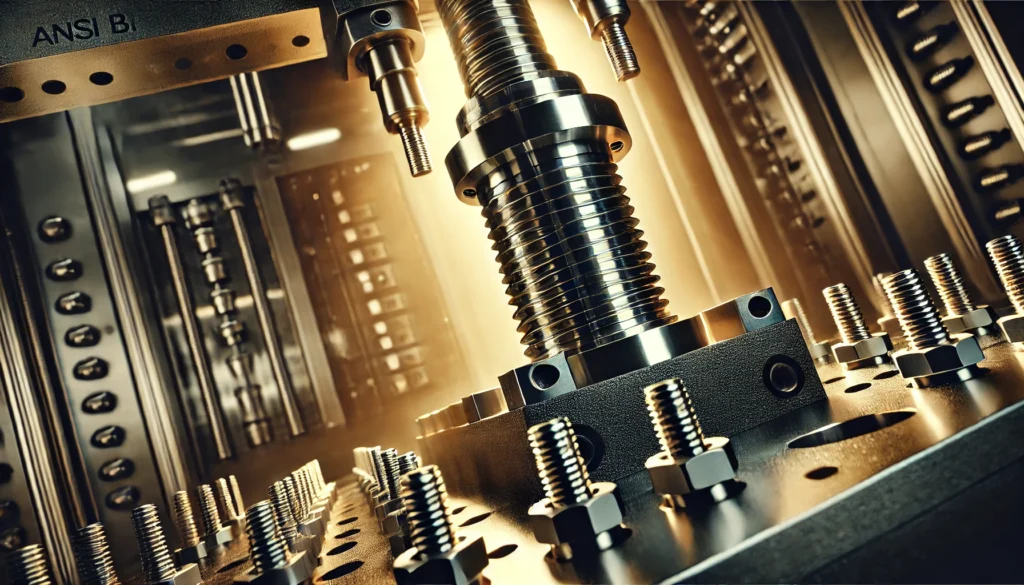
Key Characteristics:
✔ Thread Angle: 29° (compared to 30° in ISO trapezoidal threads)
✔ Thread Profile: Symmetrical trapezoidal shape with a flat crest and root
✔ Stronger than Square Threads: Better wear resistance and easier to machine
✔ Available in Multiple Classes: General-purpose, centralizing, and stub Acme
✔ Common Uses: Lead screws, machine tools, actuators, power transmission
✔ Standardization: Defined under ANSI B1.5 (General Acme Threads) and ANSI B1.8 (Stub Acme Threads)
Key Features of Acme Threads
✔ Improved Load-Bearing Capacity compared to standard trapezoidal threads
✔ Designed for Smooth Motion Transmission with reduced friction
✔ More Robust than Square Threads while easier to manufacture
✔ Available in Three Types:
- General-Purpose Acme Threads: Standard for most applications
- Centralizing Acme Threads: Tighter tolerances for increased precision
- Stub Acme Threads: Shorter thread depth for space-saving applications
✔ Used in Motion and Power Transmission Systems such as CNC lead screws, lifting jacks, and industrial presses
Acme Threads vs. ISO Trapezoidal Threads
| Feature | Acme Threads (ANSI B1.5) | Trapezoidal Threads (ISO 2901) |
|---|---|---|
| Thread Angle | 29° | 30° |
| Profile Shape | Flat root & crest | Flat root & crest |
| Strength | High | High |
| Wear Resistance | Good | Moderate |
| Manufacturing | Easier than square threads | Easier than square threads |
| Common Use | Motion transmission | Motion transmission |
Acme Thread Dimensions (ANSI B1.5, General Purpose)
The following table provides standard Acme thread dimensions for different sizes:
| Nominal Size | Threads Per Inch (TPI) | Major Diameter (in) | Pitch Diameter (in) | Minor Diameter (in) |
| 1/4-16 Acme | 16 | 0.250 | 0.202 | 0.162 |
| 1/2-10 Acme | 10 | 0.500 | 0.416 | 0.348 |
| 3/4-6 Acme | 6 | 0.750 | 0.625 | 0.545 |
| 1-5 Acme | 5 | 1.000 | 0.875 | 0.785 |
| 1 1/2-4 Acme | 4 | 1.500 | 1.375 | 1.285 |
| 2-4 Acme | 4 | 2.000 | 1.875 | 1.785 |
| 3-3 Acme | 3 | 3.000 | 2.875 | 2.785 |
| 4-2 Acme | 2 | 4.000 | 3.875 | 3.785 |
Stub Acme Thread Dimensions (ANSI B1.8)
Stub Acme threads are designed for applications requiring a shorter thread depth, making them useful for compact mechanisms and reducing material waste.
| Nominal Size | Threads Per Inch (TPI) | Major Diameter (in) | Pitch Diameter (in) | Minor Diameter (in) |
| 1/4-16 Stub Acme | 16 | 0.250 | 0.208 | 0.170 |
| 1/2-10 Stub Acme | 10 | 0.500 | 0.430 | 0.380 |
| 3/4-6 Stub Acme | 6 | 0.750 | 0.675 | 0.615 |
| 1-5 Stub Acme | 5 | 1.000 | 0.925 | 0.875 |
Common Applications of Acme Threads
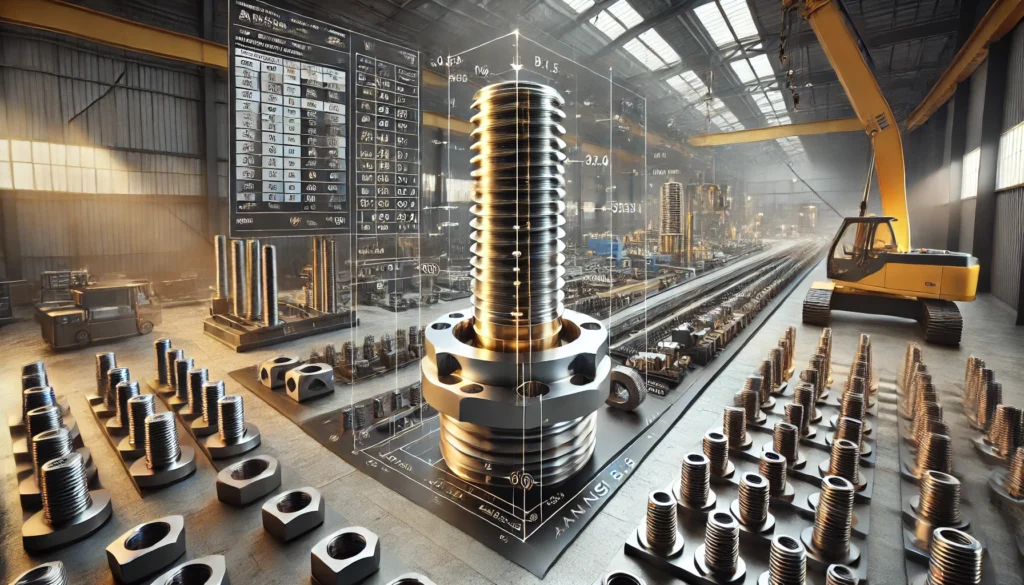
- Lead Screws in CNC Machines for precision movement
- Industrial Actuators requiring high-strength threads
- Power Transmission Screws in mechanical presses and lifting equipment
- Screw Jacks and Heavy-Duty Lifting Mechanisms
- Linear Motion Control Systems where smooth operation is required
Related Thread Standards
- ISO 2901 – Metric Trapezoidal Thread Specifications
- ISO 2903 – Tolerances for Trapezoidal Threads
- DIN 103 – German Trapezoidal Thread Standard
Important Notice on Standards Validity
This information is for reference purposes only. Users should consult official sources and updated standards to ensure compliance with current regulations. The validity of standards may change over time, so it is recommended to verify them through recognized engineering and standardization organizations (ISO, ANSI, ASME, etc.).
Check with relevant standardization bodies in your region to confirm whether a specific standard is still valid and applicable. Regulations and industry requirements may vary based on region and application.