

DIN 985 specifies hexagonal lock nuts with a nylon insert, designed to provide self-locking functionality by increasing resistance to loosening due to vibrations and dynamic loads. These nuts are commonly used in mechanical, automotive, and industrial applications where a secure and reliable fastening is required.
The nylon insert inside the nut deforms slightly when the bolt is threaded through, creating friction that prevents unintentional loosening. Unlike metal lock nuts, DIN 985 nuts do not damage the bolt threads, making them reusable under certain conditions.
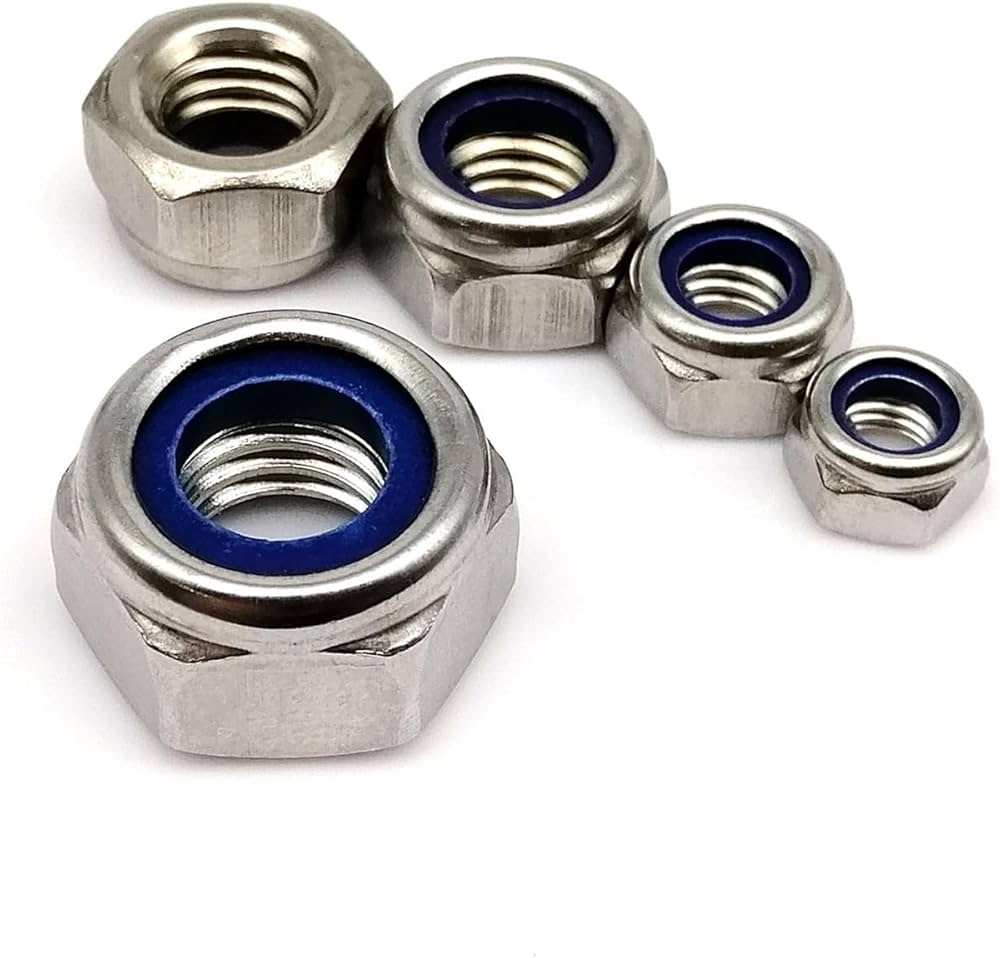
Key Characteristics
✔ Self-Locking Mechanism: The nylon insert prevents loosening due to vibrations.
✔ Non-Damaging to Threads: Unlike metal lock nuts, it preserves bolt threads.
✔ Reusable: Can be used multiple times under controlled conditions.
✔ Corrosion Resistance: Available in stainless steel (A2, A4) and zinc-plated finishes.
✔ Applications: Automotive, machinery, industrial assembly, and structural fastening.
Dimensions and Weight Chart for DIN 985 Nylon Insert Nuts
| Nominal Diameter (d) | Pitch (P) | Width Across Flats (s) | Height (m) | Nylon Insert Diameter (d1) | Weight (kg/1000 pcs) |
|---|---|---|---|---|---|
| M3 | 0.50 | 5.50 mm | 4.00 mm | 2.40 mm | 0.52 |
| M4 | 0.70 | 7.00 mm | 5.00 mm | 3.10 mm | 1.10 |
| M5 | 0.80 | 8.00 mm | 5.00 mm | 4.00 mm | 1.70 |
| M6 | 1.00 | 10.00 mm | 6.00 mm | 4.90 mm | 3.40 |
| M8 | 1.25 | 13.00 mm | 8.00 mm | 6.50 mm | 7.20 |
| M10 | 1.50 | 17.00 mm | 10.00 mm | 8.50 mm | 16.0 |
| M12 | 1.75 | 19.00 mm | 12.00 mm | 10.50 mm | 24.0 |
| M16 | 2.00 | 24.00 mm | 16.00 mm | 14.50 mm | 58.0 |
| M20 | 2.50 | 30.00 mm | 20.00 mm | 18.50 mm | 120.0 |
📌 Weight values are approximate and based on 1000 pieces.
Applications of DIN 985 Nylon Insert Nuts

- Automotive Industry – Used in engine components, chassis, and suspension systems.
- Machinery & Equipment – Provides secure fastening in mechanical assemblies.
- Construction & Steel Structures – Prevents loosening in load-bearing connections.
- Aerospace & Railways – Used in high-vibration environments.
- General Industrial Use – Suitable for applications where vibration resistance is crucial.
Standards and Compatibility
📌 Important Notice on Standards Validity
This information is for reference purposes only. Users should consult official sources and updated standards to ensure compliance with current regulations. The validity of standards may change over time, so it is recommended to verify them through recognized engineering and standardization organizations (ISO, DIN, ANSI, etc.).
📌 Check with relevant standardization bodies in your region to confirm whether a specific standard is still valid and applicable. Regulations and industry requirements may vary based on region and application.